PTAB Finds That Cannabis Delivery System Is Not a Natural Product

The Patent Trial and Appeal Board recently reversed the §101 rejection of claims directed to a composition that includes a cannabis component, an oily medium of triglycerides and mixed glycerides, a surfactant, a solubilizing co-solvent, and antioxidants, finding the invention to be eligible for patenting.1 This decision provides valuable insight into how composition claims involving naturally occurring ingredients can survive Section 101 scrutiny.

The Technology

The case involved claims to a composition for delivering cannabinoids and/or standardized marijuana extracts via the gastrointestinal system. Murty Pharmaceuticals’ composition is administered as a self-emulsifying system that avoids first-pass metabolism via targeted chylomicron/lipoprotein delivery, thereby promoting lymphatic transport.

Typically, orally administered cannabinoid formulations undergo first pass hepatic metabolism and do not reach the systemic circulation in consistent concentrations. In contrast, the claimed formulation is intended to support optimal bioavailability because the cannabis components are protected from acid catalyzed degradation.

The § 101 Rejection

The examiner rejected the claims under 35 U.S.C. §101, arguing they were directed to a natural phenomenon (e.g., product of nature) according to the Step 2A Prong 1 analysis, because the only composition requirements set forth in the composition were naturally occurring ingredients. In other words, the claimed composition simply contained a combined mixture of elements which are individually present in nature. Therefore, the examiner concluded that under Step 2A Prong 1, the claims recited a product of nature, a judicially recognized exception to subject matter eligibility.

The §101 rejection did not include a Step 2A Prong 2 analysis.

Under the Step 2B analysis, the examiner concluded that the characteristic of avoiding hepatic first pass metabolism did not add significantly more to the judicial exception, because such a physiological result would be achieved by simply administering that combination of naturally occurring ingredients.  Accordingly, the examiner found that the claims recited ineligible subject matter.

The Board’s Analysis

The PTAB reversed, disagreeing with various aspects of the §101 rejection.

  1. No Natural Product: The Board emphasized that the claims do not recite a natural product, but rather a composition formed from combining several ingredients. Importantly, the Board noted there was no evidence that this specific combination, as distinguished from the individual ingredients, exists in nature. Accordingly, the Board found that the requirements of Step 2A Prong 1 were not met.
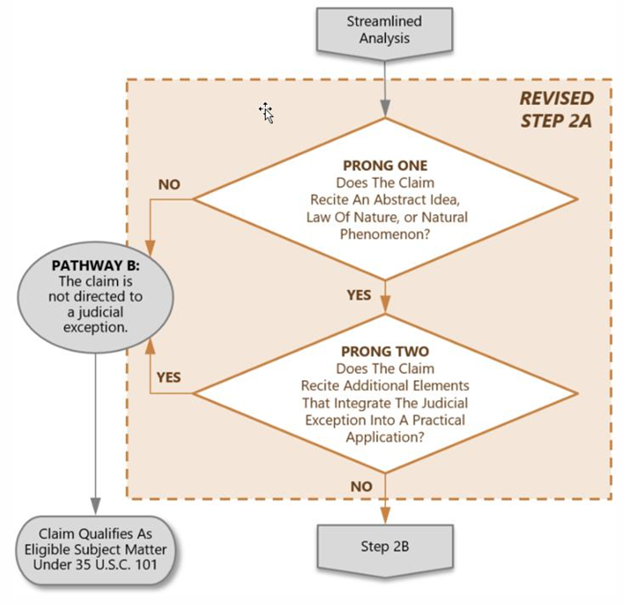
  2. Markedly Different Characteristics: The Board found that even if the individual ingredients could be considered collectively as a natural product, the claimed combination demonstrated markedly different characteristics from the individual components. Specifically, the combination created a “self-emulsifying system operable to avoid hepatic first pass metabolism via targeted chylomicron/lipoprotein delivery, thereby promoting lymphatic transport.” According to this interpretation, a markedly different characteristic (MDC) provided by the combination of elements would mean that the claims did not recite a product of nature and hence were patent eligible, thereby taking the analysis from Prong One > Pathway B as depicted in the USPTO’s 2019 Revised Subject Matter Eligibility Guidance flowchart excerpted below.
  3. Integration of Judicial Exception into a Practical Application: The Board noted that the examiner did not provide a detailed analysis under Step 2A Prong 2. For example, the rejection did not expressly find that claims failed to recite additional elements that integrate the judicial exception into a practical application. According to the Board, the claims as a whole recited combinations of ingredients that purportedly provide benefits relating to the delivery of the pharmacologically active agent.
Key Takeaways for Patent Attorneys and Agents

This decision highlights important principles for patent practitioners dealing with compositions containing natural ingredients:

  • Emphasize new properties or characteristics that emerge from the combined elements, rather than limiting the discussion to the individual components
  • Describe functional improvements that arise from the specific combination of individual components

The case serves as a reminder that compositions containing natural products are not automatically patent-ineligible under §101. With careful claim drafting that emphasizes the unique properties and benefits of the claimed combination, such inventions can survive patent eligibility challenges at the U.S. Patent and Trademark Office.

PERA Implications

Although the Board found that the claims met the requirements of §101, under the currently proposed language of the Patent Eligibility Restoration Act (PERA, Senate Bill 2140) it is likely that this case would not have made it to the Board, as the examiner would likely have concluded that the composition claims met the patent eligibility requirement (e.g. pursuant to §§101(a), (b)(2)(A),(b)(2)(B)).

Related Reading

As noted above, the Board found that the requirements of Step 2A Prong 1 were not met (thus establishing patent eligibility), because there was no evidence that the specifically claimed combination of ingredients, as distinguished from the individual ingredients, existed in nature. Compare this result with the Board’s conclusion in Ex parte Stamets (2020), where the Board found the requirements of Step 2A Prong 1 were met (thus precluding patent eligibility), even though the claimed elements when considered as a combination did not occur in nature.

1 Ex parte Murty (Appeal 2023-003754; November 29, 2024) [PDF]

PTAB Finds That Probiotic Formulation Is Not a Product of Nature

The Patent Trial and Appeal Board recently reversed the §101 rejection of claims directed to a composition that includes the bacterial strain Lactobacillus plantarum 2830 and a galactooligosaccharide produced by that strain, finding the claims to be eligible for patenting.1 This decision provides important guidance on patent eligibility for compositions involving naturally occurring microorganisms.

The Technology

Both probiotics and prebiotics can be consumed or administered to individuals to promote gastrointestinal health. OptiBiotix (ProBiotix) Health’s invention relates to a probiotic-prebiotic combination, where the probiotic bacterium L. plantarum 2830 is combined with a prebiotic galactooligosaccharide (GOS). The GOS acts to modify the absorption of cholesterol for the treatment of heart disease, diabetes, or obesity.

L. plantarum 2830 naturally contains β-galactosidase, and normally uses this enzyme to digest lactose. However, the inventors discovered that by manipulating certain reaction conditions, they could get the enzyme to work in reverse and generate an oligosaccharide version of the lactose (i.e. a GOS) instead.

The § 101 Rejection

The examiner rejected the claims under 35 USC §101, arguing that both the bacterial strain and the GOS were natural products that existed together in nature. The examiner stated that neither the L. plantarum 2830 strain itself nor the GOS had been altered in any way, but rather that the GOS is produced when the strain is placed in an alternative environment. Relatedly, the examiner found that the GOS is not structurally distinct from other GOS found in nature.

The Board’s Analysis

The Board agreed with the examiner that the Lactobacillus plantarum 2830 bacterial strain derived from nature. However, the Board did not agree with the examiner’s conclusion that the claimed GOS was a natural product as well.

The Board noted that the GOS produced by L. plantarum 2830 by the reverse β-galactosidase reaction was not naturally produced, and further that L. plantarum 2830 and the GOS do not naturally occur in combination. Key to their analysis was that:

  1. The GOS is only produced under artificial conditions not found in nature
  2. The reverse β-galactosidase reaction requires manipulated temperatures and lactose concentrations

The Board also considered the question of whether the combination of the L. plantarum 2830 and the GOS, as a nature-based product containing multiple components, exhibited markedly different characteristics when compared to the L. plantarum 2830 strain alone. Under the markedly different characteristics analysis (Step 2A Prong One), the Board looked at two interpretations of the claimed composition:

  • the bacterial strain and the GOS made within it by the bacteria’s own enzyme reaction
  • the bacterial strain and the GOS combined

Under the first interpretation, the Board concluded that such a composition is markedly different from the strain that exists in nature, because GOS would not be present in the strain in its natural environment. The Board also noted there is a structural difference between the strain in its natural environment and the claimed composition.

Under the second interpretation, the Board concluded that no markedly different characteristic was demonstrated, and then turned to the question of whether the claim as a whole integrated a judicial exception into a practical application (Step 2A Prong Two). Relevant to this aspect of the analysis, for the combined strain and the GOS, the applicant provided evidence of improved cholesterol reduction compared to combinations using GOS from other sources, demonstrating that the combination of elements recited in the claim integrated the judicial exception into a practical application.

With reference to the USPTO’s 2019 Revised Subject Matter Eligibility Guidance reflected in the flowchart provided below, it can be seen that under Step 2A Prong One, the claims involved a product of nature (L. plantarum 2830). According to the first interpretation, a markedly different characteristic (MDC) was provided the overall combination of elements and hence a natural product was not claimed, thereby taking the analysis from Prong One -> Pathway B. According to the second interpretation, a MDC was not present and hence a natural product was claimed, yet the claim as a whole provided sufficient integration, thereby taking the analysis from Prong One > Prong Two > Pathway B. Under either interpretation the claim recited patent eligible subject matter under 35 U.S.C. §101.

Key Takeaways for Practitioners

This decision highlights several important points for the patent eligibility of compositions involving natural products:

  1. Products produced by natural organisms may not be interpreted as natural products when they are made under artificial conditions
  2. Evidence of unique structural characteristics or improved functionality can help establish eligibility
  3. Multiple claim interpretations should be considered in the eligibility analysis

The case provides valuable guidance for drafting and prosecuting claims involving natural products, particularly in the microbiology space.

PERA Implications

Although the Board found that the claims met the requirements of §101, under the currently proposed language of the Patent Eligibility Restoration Act (PERA, Senate Bill 2140) it is likely that this case would not have made it to the Board, as the examiner would likely have concluded that the composition claims met the patent eligibility requirement (e.g. pursuant to §§101(a), (b)(2)(A),(b)(2)(B)).

1 Ex parte O’Hara (Appeal 2023-003678; December 10, 2024) [PDF]

PTAB Doubles Down on Natural Products Doctrine in Human Milk Case

The Patent Trial and Appeal Board recently affirmed the §101 rejection of claims directed to a nutritional human milk product, finding the claims to be ineligible for patenting.1 The decision offers some interesting insights into how the Board analyzes patent eligibility for biotech inventions, particularly those involving purified or modified natural products.

The Technology: Not Your Average Milk

The case involved BIOMILQ’s technology for an isolated nutritional human milk product. The key claimed features were that the milk product included:

  • a human milk protein
  • a human lipid
  • a human polysaccharide

The claimed milk product was also required to be:

  • sterile (free of microorganisms)
  • free of cell culture medium
  • free of environmental contaminants or certain food allergens

The § 101 Analysis: A Natural Products Deep Dive

As an initial matter, the Board agreed with the Examiner that the primary components recited in the claims (i.e. protein, lipid, and polysaccharide) are found in a naturally occurring product, namely human breast milk.

In determining whether the claims recited a judicial exception to §101, the Board’s analysis focused heavily on whether the claimed milk product was “markedly different” from naturally occurring breast milk. Here’s where things got interesting:

Environmental Contaminants & Allergens

The Board wasn’t convinced that being free of contaminants and allergens distinguished the product from nature. They cited evidence that breast milk from women in non-industrialized areas often lacks environmental contaminants, and milk from women avoiding certain foods naturally lacks those allergens.

The Sterility Question

The most fascinating part of the analysis centered on sterility. While the applicant provided expert declarations stating that natural breast milk contains beneficial bacteria, the examiner cited a scientific journal that found some breast milk samples to be sterile.

The Board applied a preponderance of the evidence test, and refused to agree with the applicant that sterile human milk is not naturally occurring. The Board went on to say that even if sterile human milk does not occur naturally, the absence of naturally occurring bacteria from the claimed milk product is insufficient to make the milk product markedly different from natural human milk. They analogized to Myriad, in essence saying that just as isolating DNA doesn’t make it patent-eligible, removing naturally occurring bacteria from milk doesn’t create marked differences.

Key Takeaways for Practitioners

  1. Natural Products Strategy: When claiming a modified natural product that lack certain natural components, ensure that the absence of those natural components makes the modified product markedly different from the product as it occurs in nature.
  2. Evidence Can Be Helpful: The Board considered both published evidence and expert declarations when evaluating whether the claimed product was naturally occurring. Having publications and/or declarations supporting your position on natural occurrence can be useful.
  3. The Myriad Shadow: The decision shows how Myriad’s principles continue to be applied broadly – mere isolation or purification of natural products, even with beneficial results, may not be enough for patent eligibility.

This decision highlights certain challenges which may be encountered when pursuing patents on purified or modified natural products.

PERA Implications

Under the currently proposed language of the Patent Eligibility Restoration Act (PERA, Senate Bill 2140), the human milk product claims that were found ineligible by the Board would likely have been found to meet the patent eligibility requirement (e.g. pursuant to §§101(a), (b)(2)(A)).

1 Ex parte Strickland (Appeal 2024-002927; December 10, 2024) [PDF]